Store Norske Arkitekt - Type family inspired by Norwegian functionalist architecture, drawing on building signage and historical alphabets.
 Store Norske Arkitekt.pdf
Buy License
Store Norske Arkitekt.pdf
Buy License
 Store Norske Arkitekt.pdf
Buy License
Store Norske Arkitekt.pdf
Buy License
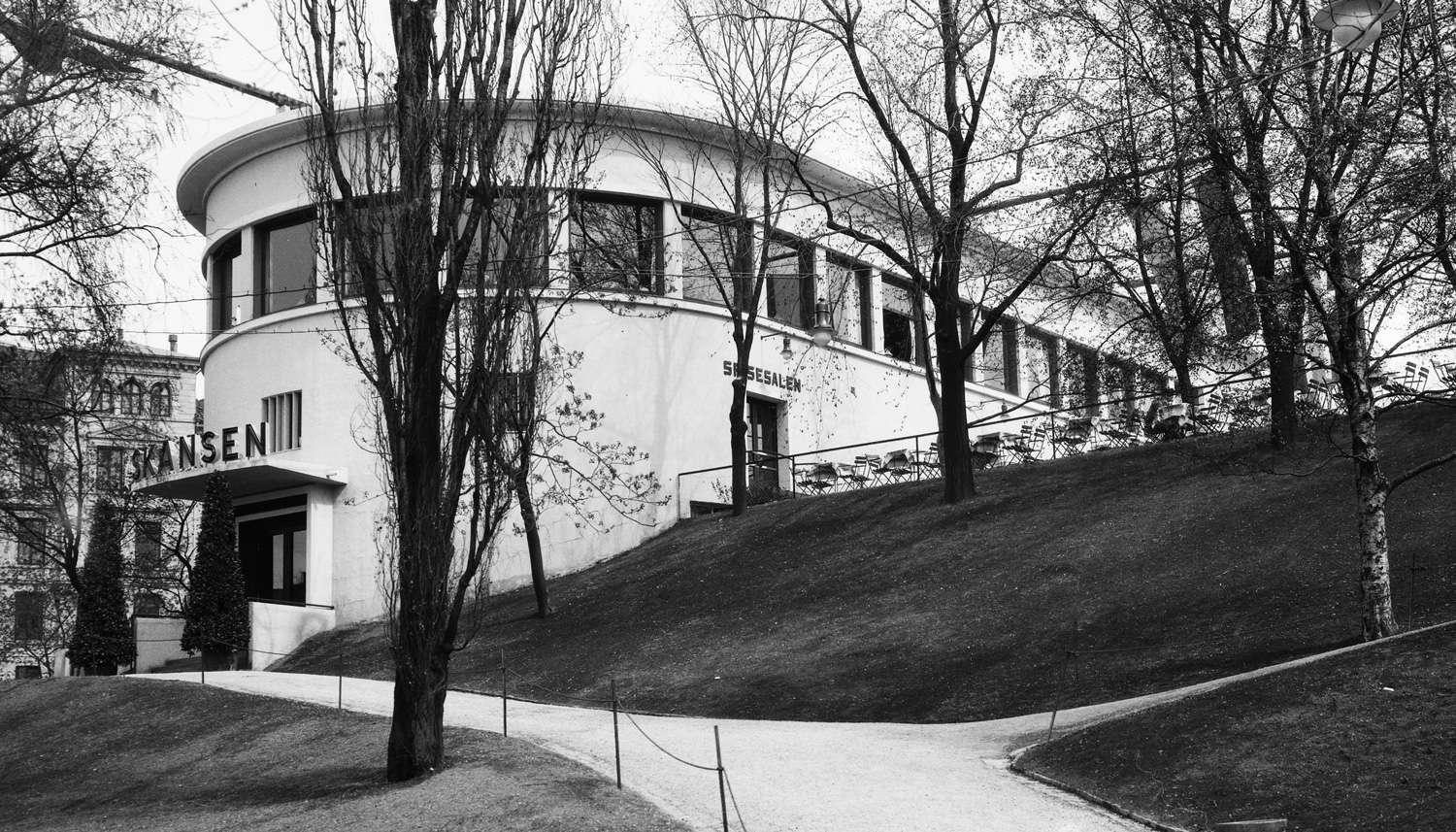
Restaurant Skansen in Oslo, designed by Lars Backer (1927). Photograph: Mittet & Co / Oslo Museum.
About
Store Norske Arkitekt is a geometric typeface inspired by Norwegian functionalist architecture, drawing on the shapes of its buildings and the lettering found on them. The first functionalist building in the Nordic countries was Restaurant Skansen in Oslo, designed by Lars Backer (1927). Around the same time, Trygve M. Davidsen developed a geometric lettering alphabet, later published in Typografisk Skissering (1933). Other examples include Per Grieg's lettering on Bergens Sjøfartsmuseum (1927) and Davidsen's for Møre Landbruksselskaps Jubileumsutstilling (1931).
The functionalists wanted their design to be guided by practical considerations, aiming to exclude anything visually redundant. They believed in pure forms and that form should follow function. Rather than a style, functionalism was meant to be a method. Yet, despite this intent, many buildings shared common, redundant features: simple geometric elements that were easy to imitate, even without understanding their purpose. At the time, these superficial imitations were referred to as Funkis.
It appears that the most successful functionalist buildings were designed by architects trained in neoclassical architecture. With a more established sense of function and a deeper understanding of proportion and rhythm, these architects could solve complex problems with simple forms. They often included unusual features, adding spirit and vibrancy to their buildings.
In a similar manner, the aim of Store Norske Arkitekt was to create a typeface that operates within the functionalist language, yet remains rooted in the knowledge of genres that came before it, echoing how the good functionalist architects built on past traditions while innovating in form.
Store Norske Arkitekt aims to capture the essence of Norwegian functionalist architecture by creating a typeface that uses the functionalist visual language while remaining connected to earlier typographic traditions. This approach reflects how leading functionalist architects built on past knowledge to innovate in form and function.
Notable Norwegian functionalist buildings include Ekebergrestauranten (Lars Backer, 1929), Kunstnernes Hus (Gudolf Blakstad, 1930), Hvalstrand Bad (André E. Peters, 1934), and Kalmarhuset (Leif Grung, 1936). Other architects of the era include Arne Korsmo, Sverre Aasland, Herman Munthe-Kaas, and Eindride Slaatto.
See also SN Tango for a more playful geometric typeface.
Store Norske Arkitekt is designed by Arve Båtevik.